DefectsPaper
The critical Rayleigh number for freckles depends on alloy composition
MIT and ORNL derive a criterion for the onset of local remelting in the mushy zone. Its critical value is not an alloy constant – it changes along the solidification path and shifts noticeably even within a narrow composition range.
Macrosegregation was described by Biringuccio as early as 1540, and it remains one of the main causes of scrap in large castings. Its nastiest forms are A-type channel segregates in large steel ingots and freckles in directionally solidified nickel-alloy castings. They go by different names, but they form the same way.
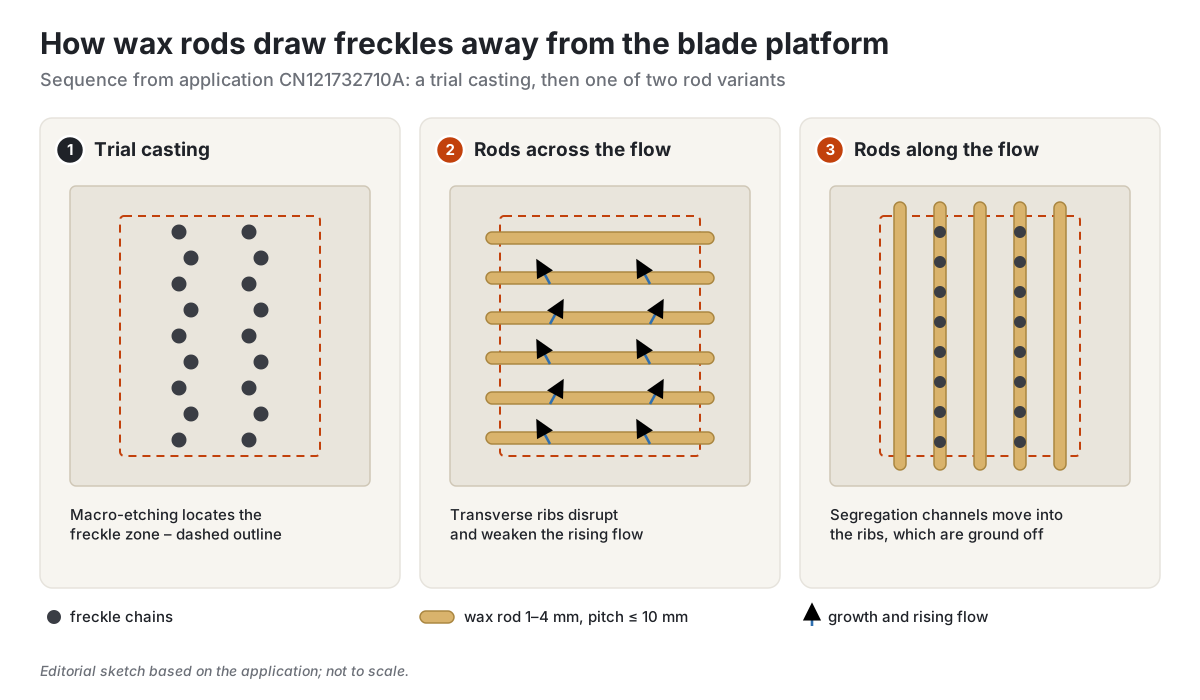
During solidification, segregation enriches the liquid in the mushy zone in some elements and depletes it of others, and its density departs from that of the melt above. In nickel superalloys the interdendritic liquid is enriched in light aluminium and titanium and depleted of heavy tungsten and rhenium – it is lighter. A rising flow starts. When it is strong enough, the cold enriched liquid begins to arrest solidification and even remelt the mushy zone. Channels form – chimneys through which plumes of enriched liquid escape into the melt. The channels then freeze with a near-eutectic composition and show up in a single crystal as chains of stray grains – freckles.
What is wrong with earlier criteria
Channel risk has long been judged with empirical criteria – functions of the local gradient G and isotherm velocity R below a critical value of which channels appear. For steels, one example is the Suzuki–Miyamoto criterion: when R2.1·G falls below a critical value, A-type segregates form in the ingot.
The authors acknowledge that such criteria capture the general dependence on casting conditions well, but are of little use for understanding the effect of composition or for designing an alloy. They apply only to the geometries and compositions they were derived from, lump several effects into one empirical parameter, and their accuracy is bounded by experimental precision. Rayleigh-number criteria are more physical, but their critical value is also usually taken as a constant fitted to experience. The work of Houghton (MIT), Sabau (Oak Ridge National Laboratory) and Olson (MIT) is an attempt to derive that threshold from the mechanism.
What they proposed
The authors took Flemings' classic model of an idealised, initially stagnant mushy zone and asked: under what condition does a buoyancy-driven flow that suddenly starts not just pass through the zone but begin to remelt it locally? Remelting opens a channel, the channel draws in the flow, and a freckle is born. From that condition they derived an expression in the form of a Rayleigh number – the ratio of buoyancy forces driving the flow to the forces resisting it – and its critical value, Racrit, above which the remelting condition is met.
The key result is what the threshold is made of: the latent heat of fusion, the change in solid fraction with liquidus temperature and the local specific heat. All three are computed with CALPHAD for a specific composition, and all three are sensitive to it. Hence the conclusion: earlier reports of a single Racrit value for castings are not supported by the authors' expressions, and a single threshold cannot be assumed for an alloy family.
The second consequence is that the threshold depends on the local average solid fraction in the mushy zone, so it changes during solidification. Comparing Ra with the threshold at a single point is not enough – the whole solidification path has to be examined.
The checks
How it was checked on a nickel alloy
Single-crystal blades are cast by directional solidification, and those conditions match the model's assumptions very closely. For validation the authors used Pollock and Murphy's data on SX-1: one casting geometry and one composition under different cooling conditions, near the limit where single-crystal growth breaks down and freckles appear. For each condition it is known whether freckles formed.
The density difference, the change of liquid fraction with temperature, the viscosity, the latent heat and the specific heat were computed with CALPHAD along a Scheil solidification path. PDAS came from the relation found in the same Pollock and Murphy study, and mush permeability from the Poirier relation.
The result: Racrit for SX-1 falls monotonically as the solid fraction rises. The casting's Ra is small at low solid fraction – segregation has not yet changed the liquid density much – then rises and passes a maximum. Where the Ra curve rises above the threshold the remelting condition is met, and these are mostly the conditions under which Pollock and Murphy saw freckles.
Pb–Sn alloys and steel ingots
For Pb–Sn alloys the criterion was compared with published experiments and simulations, again with good agreement. An interesting exception: sometimes the remelting condition is met at high solid fraction, yet no sustained channels form. There the mush permeability is low, flow is hindered, and perturbations apparently do not have time to grow into channels.
For steels the authors took 27 experimental ingots from the work of Yamada and co-workers and of Suzuki and Miyamoto – both commercial ingots of 9–400 t and 15 kg laboratory ingots that mimic them by side cooling. Ra and the threshold were computed with a CALPHAD iron database at 30% solid fraction – the undercooling at which A-type segregation appeared in the trials. The trends agreed with the empirical Suzuki criterion. The model also explains why steels with a narrow freezing range and little buoyancy inversion are the most resistant to A-type segregation.
Where the model does not fit
The authors discuss the exceptions themselves. For some SX-1 conditions the remelting condition is met, yet no freckles were seen. In one case Ra exceeds the threshold only marginally, and the uncertainty in Ra from the velocity and PDAS is about 20%, so it is within error. In three others the excess is clear, but these are high-gradient, low-velocity conditions: the front advances slowly and the mushy zone is thin. Whether the model's assumptions hold there, or whether such conditions simply keep perturbations from growing into channels, the paper leaves open.
The model also ignores what can alter flow in a real casting: mould geometry, cores, defects. This is a theoretical paper – no new casts were made, and validation relies on other people's benchmark data.
What it changes for the foundry
A freckle threshold fitted for one alloy cannot be carried over to another without recalculation. By the paper's logic it may need recalculating even between heats within one alloy's specification – but that is a conclusion to test on your own data, not a ready rule. And Ra should be compared with the threshold along the whole solidification path, not at a single point.
For alloy designers the paper offers a tool: a composition can be screened for freckle tendency by calculation, before casting – through the very properties the threshold is made of.
Source
- Authors
- O. S. Houghton, A. S. Sabau, G. B. Olson – MIT, Oak Ridge National Laboratory, QuesTek Innovations, USA
- Published in
- Acta Materialia, 319, 122362 (19 May 2026)
- Access
- subscription; accepted manuscript is open on OSTI
- Original title
- Composition dependence of the critical Rayleigh number curve for macrosegregation in multicomponent metal alloys
- Evidence
- Theory and calculation
- Read from
- the full text
Added: 3 November 2026.