SuperalloysPaper
VZhL22 with 2% rhenium – how withdrawal rate and pouring temperatures affect single-crystal yield
VIAM ran a three-factor designed experiment on a UVNK liquid-metal-cooling furnace and obtained regression models for yield, orientation and PDAS.
Over the past 15–20 years, the authors write, the main advances in cast nickel superalloys have come from carbon-bearing alloys with reduced rhenium – for blades with equiaxed, columnar and single-crystal structures alike. Rhenium is expensive, and cutting it without losing high-temperature strength is a problem everyone is working on.
VZhL22 is such an alloy from VIAM: 2 wt% rhenium, high phase stability and improved high-temperature strength. The specific stress-rupture strength of its <001> single crystals at 1000 °C for 100 hours is about 28 MPa/(g/cm³). But to get those properties in a blade, one first has to learn to cast a sound single crystal from the new alloy reliably. That is the subject of Part 1 of the study; mechanical properties are promised in Part 2.
What counts as a sound single crystal
The authors recall what drives the result. Directionally solidified single-crystal castings have a cellular-dendritic structure with marked non-uniformity within the cells. Rhenium, tungsten, ruthenium and cobalt go to the dendrite cores, while chromium, molybdenum, titanium, aluminium, tantalum, niobium and hafnium go to the interdendritic regions: the former raise the melting point of nickel, the latter lower it. Hence non-equilibrium eutectic γ′ and casting pores between dendrites. Yield, single-crystal perfection, non-uniformity, pores, eutectic and dendrite cell size all depend strongly on casting parameters.
A casting counts as a sound single crystal here if its <001> axis deviates from the casting axis by no more than 10°, crystallite misorientation within the crystal is no more than 3°, and the surface shows no high- or low-angle boundaries, freckles, "shoot-throughs", equiaxed grains or other growth defects.
How the trial was run
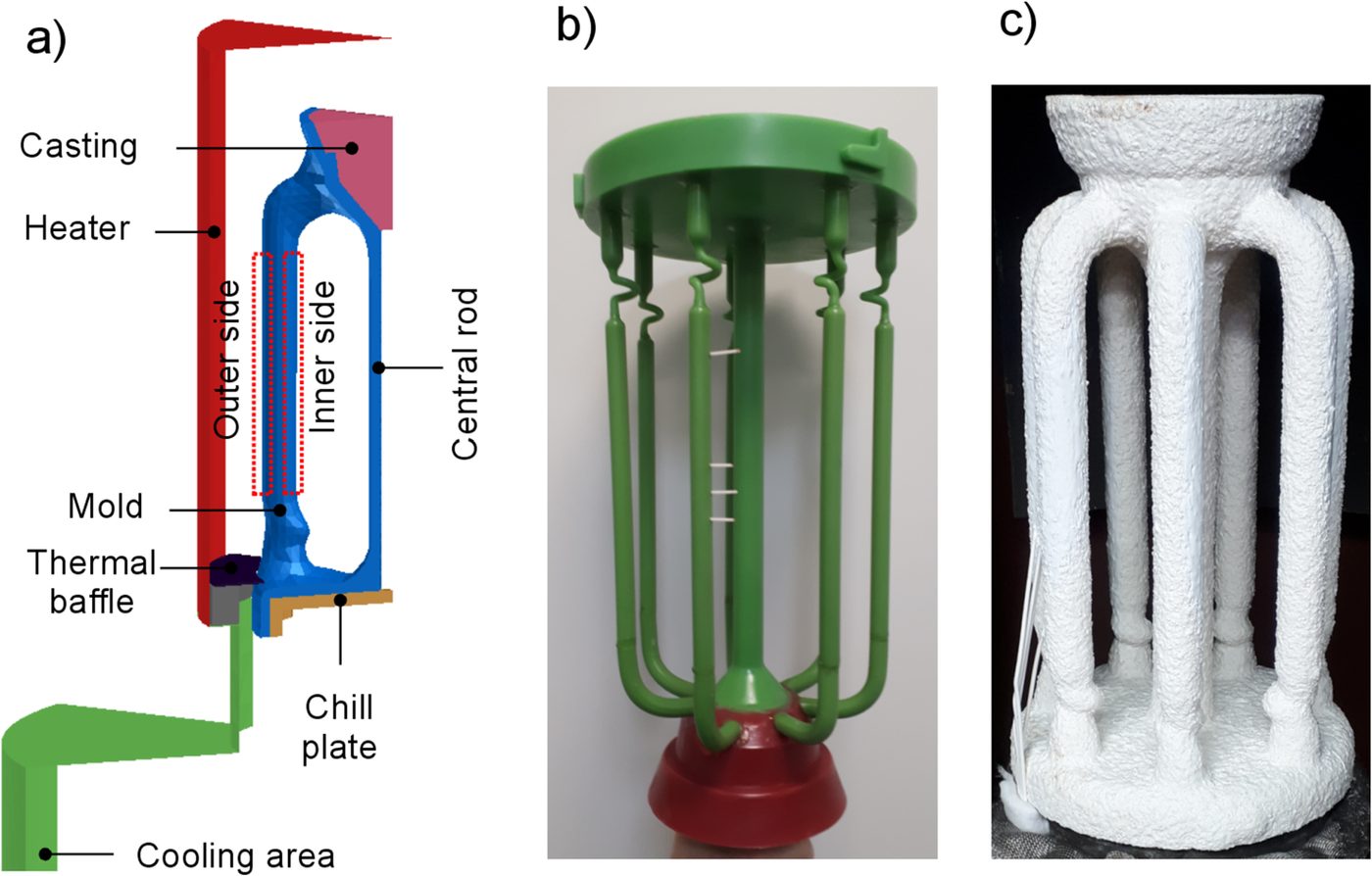
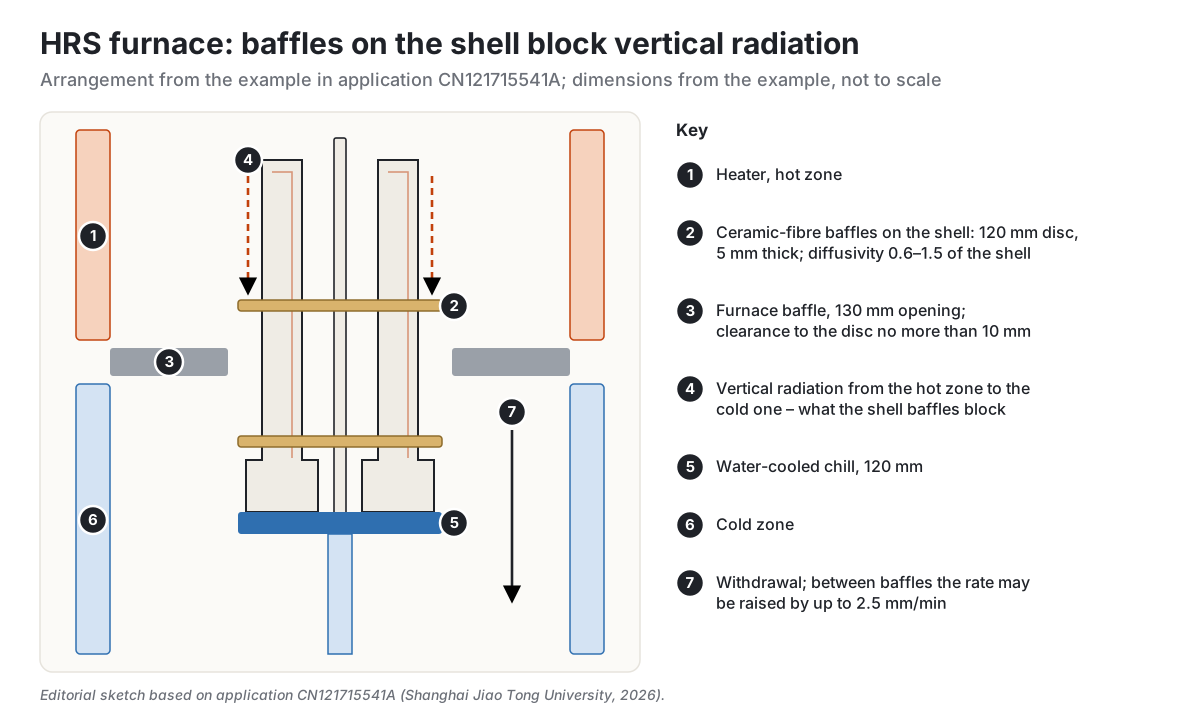
Cylindrical specimens 15 mm in diameter and about 165 mm long with a starter cone were cast nine to a cluster on Ni–W seeds oriented along <001>. The alloy was vacuum-induction melted using the practice for rhenium-bearing alloys. The furnace was an industrial UVNK-type unit: the mould with the melt moves from the hot zone through a heat shield into liquid aluminium (liquid-metal cooling, LMC).
Three factors were varied in an orthogonal second-order design: 23 + 2·3 + 1 = 15 runs. The main levels were:
- solidification rate – 4, 7 and 10 mm/min;
- melt temperature in the mould before solidification (set by the lower heater) – 1580, 1605 and 1630 °C;
- melt temperature in the crucible before pouring – 1600, 1640 and 1680 °C.
Besides eight corner points and the centre, the design has six "star" points at 1.215 intervals from the centre – slightly beyond the main range for each factor. All other parameters were kept as usual for casting blades of rhenium-bearing alloys on these furnaces.
The design
Yield was judged from the macrostructure after etching in hydrochloric acid with hydrogen peroxide. Orientation was measured by X-ray on a DRON-4 diffractometer using the rocking-curve method on (004) reflections, on a transverse cut through the starter cone; the rocking curves gave both the <001> deviation and the crystallite misorientation. Pore and eutectic fractions and dendrite arm spacing were measured on sections.
What came out
The full results table from the paper is below. Factor values at the star points were converted by us from the design codes; "–" means the eutectic fraction was not measured in those runs.
| No. | R, mm/min | Mould T, °C | Crucible T, °C | Yield | Pores, % | Eutectic, % | λ, µm | <001> deviation, ° | Misorientation, ° |
|---|---|---|---|---|---|---|---|---|---|
| 1 | 4 | 1580 | 1600 | 0.67 | 0.25 | 2.6 | 284 | 2.9 | 2.0 |
| 2 | 10 | 1580 | 1600 | 0.33 | 0.19 | 2.8 | 275 | 2.9 | 4.0 |
| 3 | 4 | 1630 | 1600 | 0.61 | 0.24 | 3.5 | 315 | 1.7 | 2.1 |
| 4 | 10 | 1630 | 1600 | 0.50 | 0.11 | 2.3 | 291 | 4.2 | 2.5 |
| 5 | 4 | 1580 | 1680 | 0.44 | 0.45 | 3.5 | 363 | 3.3 | 2.5 |
| 6 | 10 | 1580 | 1680 | 0.55 | 0.21 | 3.8 | 275 | 1.9 | 3.2 |
| 7 | 4 | 1630 | 1680 | 0.61 | 0.25 | 2.3 | 305 | 2.5 | 2.5 |
| 8 | 10 | 1630 | 1680 | 0.44 | 0.08 | 3.2 | 281 | 2.6 | 2.5 |
| 9 | 3.4 | 1605 | 1640 | 0.78 | 0.12 | 2.6 | 338 | 4.1 | 1.5 |
| 10 | 10.6 | 1605 | 1640 | 0.67 | 0.09 | – | 291 | 4.4 | 1.5 |
| 11 | 7 | 1575 | 1640 | 0.67 | 0.10 | – | 314 | 5.1 | 2.1 |
| 12 | 7 | 1635 | 1640 | 0.67 | 0.22 | – | 321 | 5.0 | 1.6 |
| 13 | 7 | 1605 | 1591 | 0.56 | 0.10 | – | 310 | 3.4 | 1.9 |
| 14 | 7 | 1605 | 1689 | 0.78 | 0.17 | – | 334 | 1.5 | 2.1 |
| 15 | 7 | 1605 | 1640 | 0.78 | 0.24 | – | 328 | 2.0 | 2.4 |
Regression models were built from these data, and the authors conclude:
- lowering the rate from 10 to 4 mm/min raises yield markedly at all temperatures;
- yield peaks in the middle of the temperature range, at 1640 °C in the crucible and 1605 °C in the mould;
- the <001> deviation depends only on the crucible temperature and becomes smaller when that temperature moves away from its mid value in either direction;
- crystallite misorientation, porosity and eutectic fraction did not change statistically within the range studied and averaged 1.52°, 0.12 and 3.0 vol.%;
- dendrite arm spacing is most affected by rate: it decreases as the rate goes up, and moving the temperatures away from their mid values strengthens that effect.
The table also shows the downside of a high rate: the worst yield, 0.33, is in run 2, at 10 mm/min and the lowest temperatures.
What the structure looks like
The as-cast alloy has a normal dendritic-cellular structure of primary and secondary dendrites with interdendritic spaces. Primary dendrite axes run along the casting axis or deviate from it by a small angle. The matrix is nickel γ solid solution strengthened by cuboidal γ′ particles based on Ni₃(Al, Ta); the particles are finer in the dendrites than between them. Interdendritic spaces contain plate-like tantalum-based MC carbides and eutectic (peritectic) γ′.
Limits
These are cylindrical specimens, not blades with platforms and cores. One furnace and one cooling method. Nine castings per run is a small sample for judging yield: one reject shifts the fraction by 0.11. The regression models hold only inside the range studied and should not be extrapolated.
The work is useful as a guide to the process window for rhenium-bearing alloys of this class under liquid-metal cooling, and as an example of a designed experiment giving a quantitative picture of three parameters in 15 heats instead of trial and error.
Source
- Authors
- O. N. Bityutskaya, N. V. Petrushin, E. M. Visik, N. A. Kuzmina, N. A. Lonskaya – NRC Kurchatov Institute – VIAM, Moscow
- Published in
- Trudy VIAM, no. 1 (155), pp. 3–18 (2026)
- Access
- open
- Licence
- CC BY
- Original title
- Структурные характеристики монокристаллических отливок и механические свойства жаропрочных никелевых сплавов с низким содержанием рения. Часть 1
- English title
- Structural characteristics of monocrystalline castings and mechanical properties of nickel-based superalloys with low rhenium content. Part 1
- Evidence
- Experiment
- Read from
- the full text
- VZhL22
- Rhenium
- Liquid-metal cooling
- Withdrawal rate
- Orientation and misorientation
- Dendritic structure, PDAS
- Design of experiments
Added: 3 November 2026.