DefectsPatent
Wax rods on the pattern draw freckles away from a single-crystal blade
A patent application: where freckles show up on a trial casting, thin wax rods are attached to the pattern across or along the convection flow. The segregation channels move into these ribs, which are ground off afterwards.
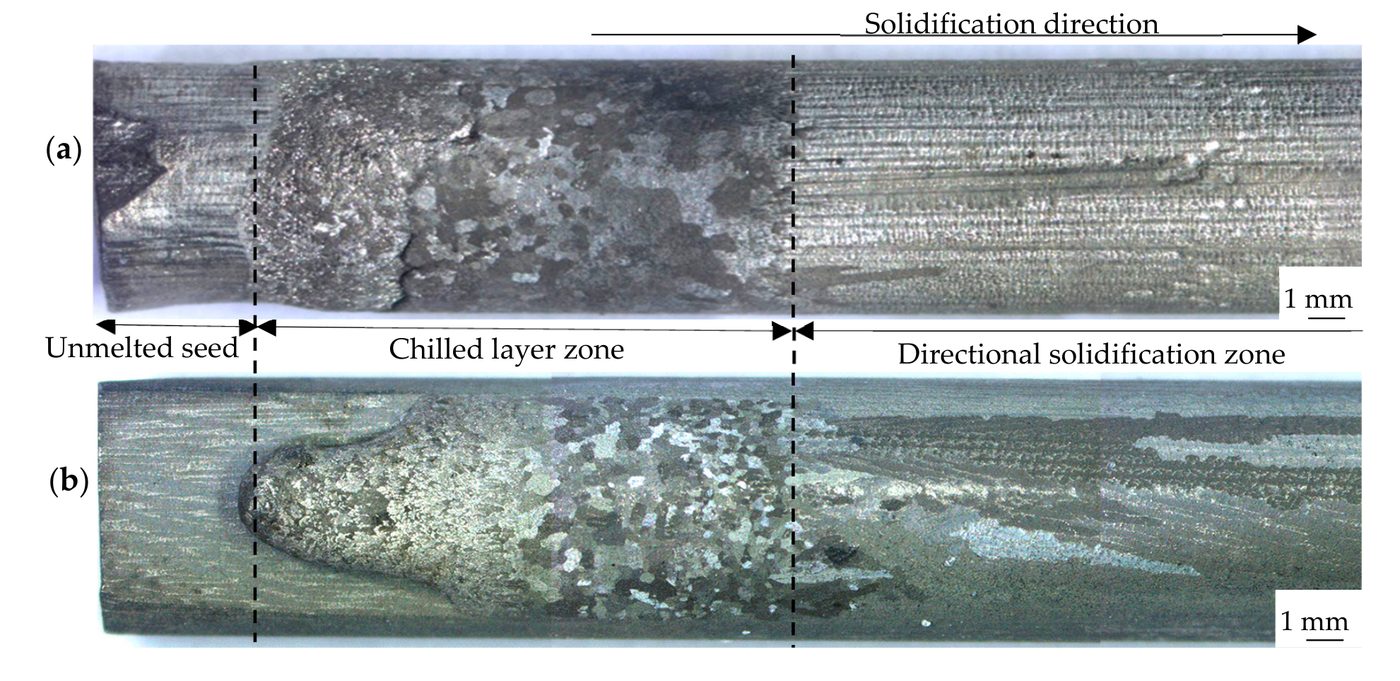
Freckles are chains of small equiaxed grains stretched along the growth direction on the surface of a single-crystal casting. For a blade they are a reject: surface stray grains break the single crystal, and the blade will not be accepted. The classic cure is known – raise the thermal gradient, shorten the mushy zone, weaken convection in it. But as aero-engine and especially gas turbine blades grow larger, the applicant says, freckles have become an almost unavoidable defect, particularly in later-generation alloys rich in refractory elements. For large blades of complex shape the usual measures help little, the authors of the application say.
An application by Shenzhen Wedge Aviation Technology proposes to act on the pattern geometry rather than on the process: to move freckles off the casting body into purpose-made ribs that are ground off afterwards.
Where freckles come from
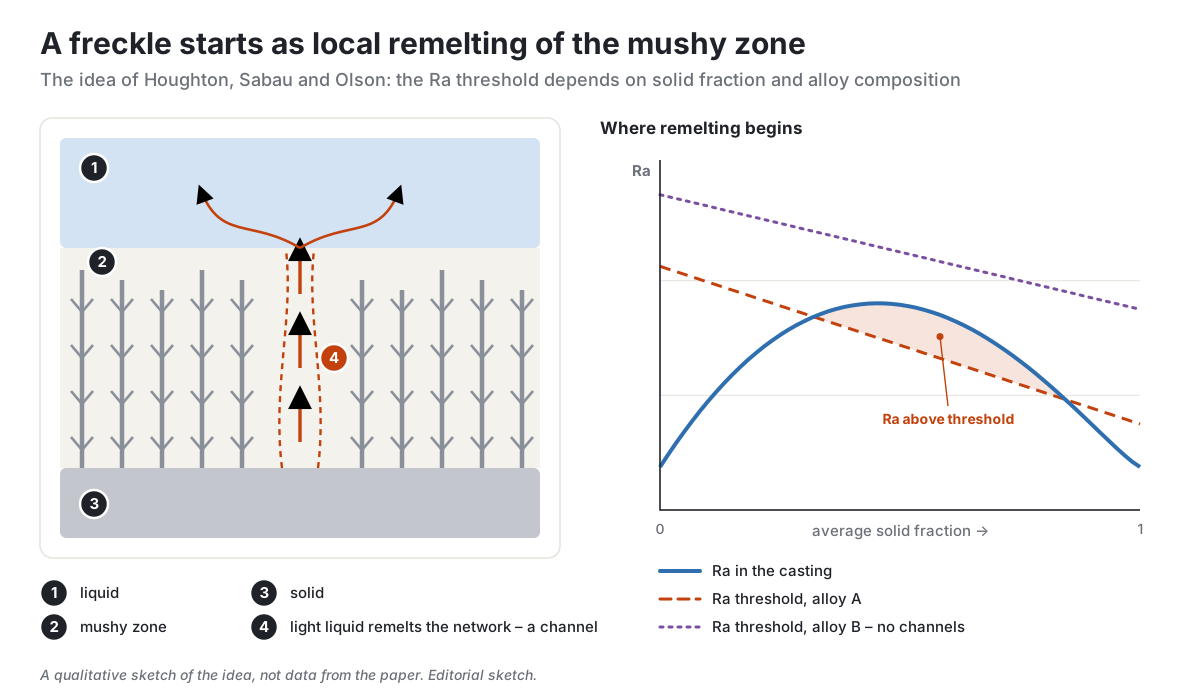
The application's explanation is the classic one. During directional solidification, segregation changes the composition of the liquid in the mushy zone, making it lighter than the melt above. The resulting "heavy on top, light below" state is unstable, and macroscopic convection starts in the mushy zone. The flow breaks thin, freshly frozen dendrite arms; the fragments are carried away and leave chains of equiaxed grains on the casting surface.
The usual remedy is process-based: a steeper gradient, a shorter mushy zone, weaker convection. For large blades of complex shape, the applicant says, that is not enough. Hence the idea of acting where the flow forms along the wall – on the shape of the surface.
What is claimed
The claims are short:
- claim 1: when the pattern is assembled, a wax rod is attached where freckles appear on the casting – either perpendicular or parallel to the direction of liquid convection;
- claim 2: the location and size of the area come from a macro-etched trial casting;
- claim 3: the sequence – pattern assembly with rods, normal shell, pouring and directional solidification in a vacuum furnace, then removal of the extra metal at the rods;
- claim 4: rod diameter 1–4 mm, pitch no more than 10 mm;
- claim 5: the rods go on the blade platform.
Parameters from the claims
How it is done
A trial blade is first cast with the standard process. The trial pour must match the production pour exactly – same mould, same settings. The casting is macro-etched, the grains examined, and the area where freckles appear located, with its length and width measured. These dimensions decide where and which rods to attach.
Then, as the cluster is assembled in the normal way, rods are attached to that area of the pattern so that they cover it completely. The rod cross-section may be round, square or another shape. Next comes the usual shell – alumina in the example, dip and stucco, 5.5 coats. Pouring follows the blade's production settings in a vacuum directional-solidification furnace. After knock-out and removal of the gating, the extra metal at the rods is ground off.
The two variants
Rods across the flow. They create transverse ribs on the casting surface and a matching relief on the inner surface of the shell. The liquid flowing along the wall runs into these ribs, is disrupted and weakens – convection has no room to build up.
Rods along the flow. Here the logic is reversed: the rods give convection an easier path. The segregation channels move into these raised ribs, and freckles form there rather than on the casting body.
In both examples in the description the rods were placed on the blade platform, where freckles appeared especially often, and according to the description the freckles ended up on the rods. After the ribs were dressed off, the casting was free of freckles.
What supports it
Only two examples with photographs of castings. No alloy is named, there are no batch statistics, and no metallography under the dressed area. The mechanism is explained qualitatively, without a flow calculation.
A curious detail: several inventors – Ma Dexin, Deng Yangpi, Wei Jianhui, Cheng Bowen – share their names with the authors of the Central South University paper on the seed gap. It appears to be one group with a long-standing interest in single-crystal casting defects.
The catch
The idea is simple and cheap, but it raises obvious questions. Ribs on the surface are new places where a stray grain can start: any abrupt change in section and heat flow is dangerous for a single crystal. The blade design must allow stock for dressing at exactly that spot. And dressing removes the channel only if it moved into the rib completely: if the root of a freckle stays in the casting body, a defect will remain under the dressed spot.
Source
- Number
- CN121732710A (application CN202511958035.0)
- Applicant
- Shenzhen Wedge Aviation Technology Co., Ltd.
- Inventors
- Zhao Yunxing, Ma Dexin, Yuan Yingying, Wei Jianhui, Sun Zhongyuan, Deng Yangpi, Li Lü, Gong Xiaoyi, Wu Gang, Cheng Bowen, Zhang Dan
- Filed
- 23 December 2025
- Published
- 27 March 2026
- Status
- Application, not granted
- Title (Google Patents translation)
- Single crystal blade freckle control method
- Evidence
- Claimed in a patent
- Read from
- the description and claims
Open the source: Google Patents ↗ Espacenet ↗
Added: 3 November 2026.